Feedback on intelligent wastewater recycling: KERVALIS ARMOR
12/03/2021
Better yields and a cleaner environment: these were the objectives of Kervalis-Armor in opting for an innovative installation for reprocessing water for industrial use.
Established in 1994 in Trémorel (22), the Kervalis-Armor site specialises in processing and adding value to animal by-products from abattoirs in the Grand Ouest region of France. A subsidiary of the SARIA group (1,500 employees in France), the Breton site employs 35 people. In particular, it produces transformed animal proteins (TAPs) for the pet food industry.
Increasing activity without impacting the environment: the challenge of recycling wastewater
As part of the SARIA Group's circular economy approach, the project is driven by a dual requirement: to reduce the environmental impact and to ensure the long-term viability and growth of the business. Increased production means higher volumes of waste, subject to prefectoral authorisation. In addition, the area's wastewater treatment plant had reached its maximum capacity for processing pollutant loads.
But in this context, how can we recycle wastewater from WWTP (wastewater treatment plants) for technical uses while guaranteeing water quality that is free from the slightest risk of contamination for employees and the environment? In addition, reprocessing the water meant being able to discharge additional volumes. This process is governed by the agreement signed with the Community of Communes and validated by the supervisory authority.
©Laurent Grivet_BWT-2193.jpg
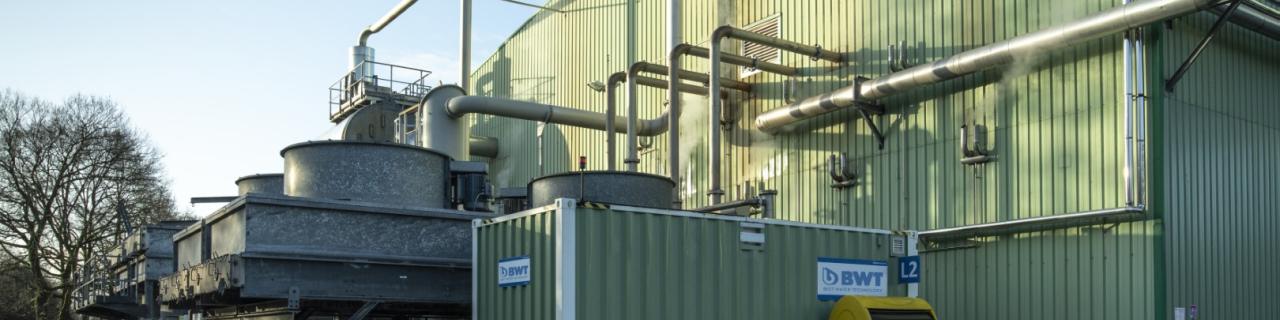
Water reprocessing in containers: a BWT speciality with the added benefit of proximity
The project was born out of an open debate and a clearly stated objective: to achieve the highest level of efficiency with the best possible water quality. In other words, the aim is to maintain the maximum efficiency of the installation between the incoming m3 and the outgoing m3.
The need for reprocessing WWTP water became apparent in 2016. Based on the technical use of recycled water, it could be used to reuse up to 50% of the site's total water consumption. Its installation in a container also met the challenges of location and speed of implementation.
" Above all, we were looking for a business-specific approach, capable of adapting the solution to the needs specific to the reprocessing of lagoon wastewater from WWTPs ," explains Anne Genouel, Project Manager in the Technical Department. "The solution also had to meet constraints relating to the location of the container, close to the utilities, and its size, so that it could absorb the increase in activity.”
Two approaches were submitted, and the BWT solution was chosen. The geographical proximity and availability of the teams were decisive factors. “All the more so as this container was the first of its kind to be set up within the Group ," stresses Anne Genouel: "BWT committed to a precise set of specifications with an obligation to achieve results. The team took the time to adapt a standard solution to all our requirements in terms of installation ergonomics, process control and maintenance".
The solution incorporates a complete filtration system that purifies, sanitises and softens the water. The process now delivers high-quality, highly efficient reprocessed water for industrial use.
Visuals ©Laurent Grivet_BWT-2071.jpg and ©Laurent Grivet_BWT-2089.jpg
Meeting the objective of reducing environmental impact
After 18 months in operation, the container is fully fulfilling its mission. BWT worked hard to optimise its installation, and provided technical support and training for the teams at the start of operations.
"Our first objective has been achieved, as we now have an efficient system capable of treating almost 15,000 m3 per year. It allows us to reject additional volumes in the event of a peak in activity, thus avoiding water stress situations such as heatwaves , for example", observes Julien Millot, site manager.
To date, the container can handle up to 60 m3. This type of project is supported by the French Water Agency, which is subsidising it. At the KERVALIS ARMOR site, the reprocessed water now guarantees that there is no risk to employees working at the facility.
"The quality criterion we have chosen takes us well beyond the required standards, and not only helps to reduce the environmental impact, but also reassures our employees that the water from the WWTP is reliable," says Julien Millot. " We are no longer limited in the volumes of waste we can discharge, and we can now consider developing new by-products“.