Green hydrogen: ultrapure water, the key to sustainable, high-performance production
26/03/2025
Hydrogen, often heralded as the energy of the future, can only fulfil its potential if the right choices are made in its production. Green hydrogen, produced by the electrolysis of water and electricity from renewable resources, is considered the most sustainable. But to guarantee the efficiency and durability of electrolysers the quality of the water used is essential. As in the pharmaceutical, cosmetics and microelectronics sectors, where BWT is a recognised player, ultrapure water is essential for producing green hydrogen.
Hydrogen and its production method
an energy spectrum
Although promising, the environmental impact of hydrogen varies depending on how it is produced. While hydrogen exists in its natural state and can be extracted from underground (this is known as "white hydrogen"), the vast majority of hydrogen used today is produced using a variety of techniques. There are many different techniques, with varying degrees of eco-responsibility:
Grey, brown or black hydrogen: produced from fossil fuels (natural gas or coal) by steam reforming, this is the most common form, but also the most polluting.
Pink hydrogen: produced by electrolysis of water using nuclear electricity. Less common, it is considered a low-carbon alternative.
Yellow hydrogen: produced by electrolysis of water using an energy mix that includes renewable and non-renewable energies.
Green hydrogen: produced by electrolysis of water using electricity from renewable sources (wind, solar, hydro).
Green hydrogen is therefore the most carbon-neutral form, but also the most expensive to produce. To maximise its efficiency, the quality of the water used in the electrolysis process is essential.
Efficient green hydrogen production
thanks to ultrapure water
The production of green (but also yellow and pink) hydrogen is based on the electrolysis of water, a process that separates water molecules into hydrogen and oxygen. Ultrapure water is essential for this process, as it must be free of all impurities, minerals, chemical and organic substances. These elements can damage the electrolysers, limit their lifespan and increase maintenance costs. Ultrapure water also guarantees very low electrical conductivity, maximising the performance of electrolysis systems for the production of high-quality hydrogen, which is essential for many industrial and energy applications.
At the same time, in addition to water quality, quantitative management of water resources is also an issue for green hydrogen production plants. In this context, combined management of water recycling and reuse within the plant not only minimises the impact on local water basins, but also enhances the sustainability of green hydrogen production. This virtuous approach can also help to ensure the social acceptability of setting up production plants, by limiting the risk of competition between uses in the relevant water basins.
Ultrapure water
a controlled chain
Whatever the type of water entering the process (drinking water, surface water, borehole water or recycled water), the generation of ultrapure water is based on a three-stage chain:
Pre-filtration: this first stage eliminates suspended solids and the main particles present in the water.
Reverse osmosis: this technology purifies the water by eliminating most of the dissolved impurities. However, this stage is not sufficient to achieve the level of purity required for electrolysers.
Polishing by electrodeionization (EDI): this final stage (optional depending on the type of electrolyser) eliminates the last traces of polluting particles, producing ultrapure water with a conductivity of less than 0.1 µS/cm.
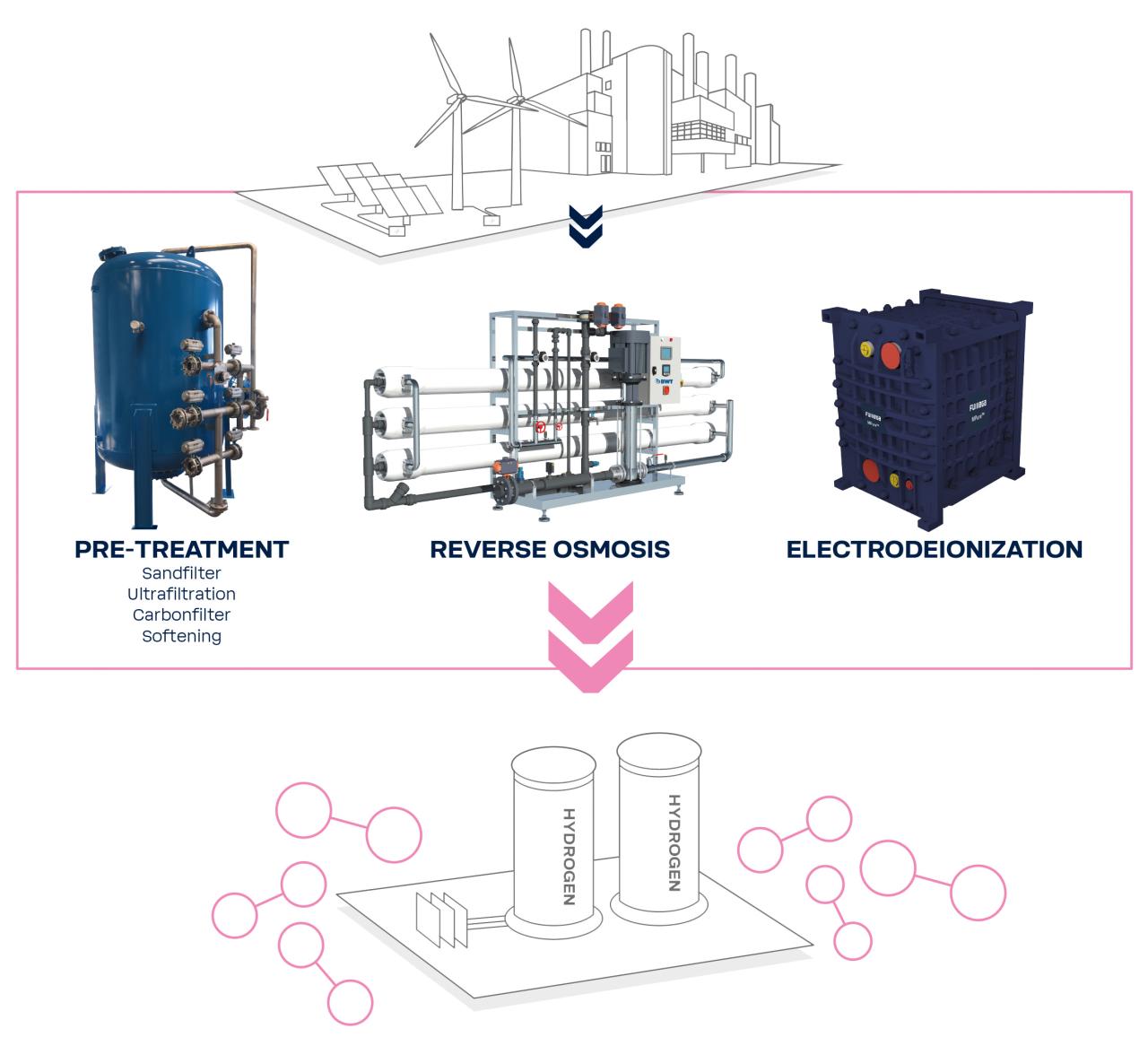
These steps guarantee a quality of water adapted to the most demanding needs of the hydrogen industry. Ultrapure water production techniques developed progressively over the course of the 20th century, particularly with the refinement of reverse osmosis and electrodeionization techniques in the 1960s and 1970s. The 1980s and 1990s then saw the development of ultrapure water production on an industrial scale, under the impetus and expertise of specialist companies such as BWT.
In other words, producing green hydrogen does not require any specific water treatment, but is simply a new use for ultrapure water, which is already widely used in the pharmaceutical and cosmetics industries, the semiconductor and electronics industries, and the automotive industry (battery production).
BWT expertise
serving the hydrogen industry
Over several decades, BWT has acquired extensive experience in water treatment, and recognised specific expertise in producing ultrapure water for key sectors such as pharmaceuticals and cosmetics. Today, BWT is the leader in ultrapure water production for these industries, and applies its expertise to the green, pink and yellow hydrogen industry, where the quality of the water used in the electrolysis process is a key success factor.
BWT offers innovative, high-performance solutions to meet the specific needs of manufacturers, from the design to the commissioning of water treatment facilities, including solutions for quantitative water control. Thanks to its proprietary systems and complete mastery of the ultrapure water production chain, today BWT is the preferred partner for hydrogen production plants in their quest for efficiency and sustainability.