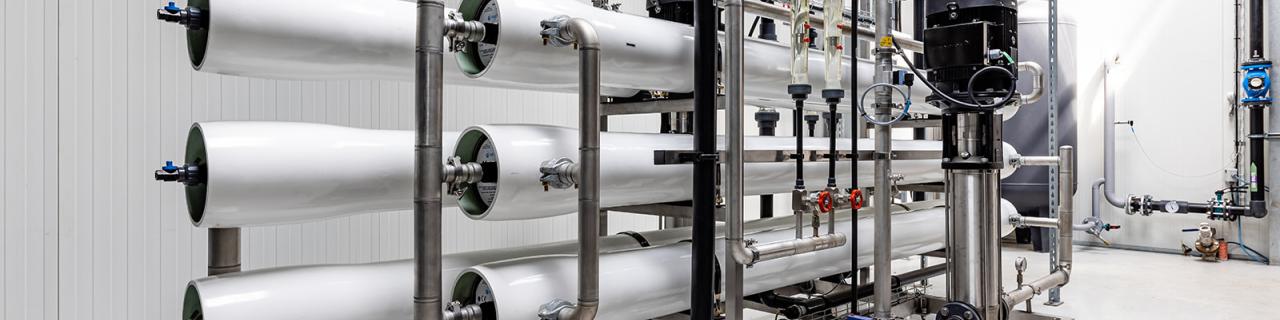
Among physical water treatments, reverse osmosis is one of the most advanced membrane-based methods for purifying water. It is a process suited to a number of industrial scenarios where water needs to be purified, desalinated, cleaned of metals and even given an antibacterial quality. In industry, osmosis is also a major way of saving water and energy.
A natural phenomenon, osmosis occurs when two liquids of different concentrations are separated by a membrane. Pure water flows through the membrane towards the liquid with the higher concentration.
By reversing this mechanism, it is possible to go from water with high concentrations to pure water. Reverse osmosis is achieved by applying a mechanical pressure greater than the osmotic pressure to reverse the flow exchange. Reverse osmosis is therefore a process for producing pure water, and this is the principle behind the use of reverse osmosis in industrial water treatment.
How an industrial osmosis unit works
An osmosis unit uses a semi-permeable membrane that allows only the water molecules to pass through. This membrane comes into play after a pre-treatment system that firstly retains the solid particles present in the water (sand, rust, for example) and the chemical components such as chlorine.
The osmosis membrane then retains the other pollutants, however fine they may be. In particular, this membrane retains ions such as nitrates, micropollutants, endocrine disruptors (chlorates and perchlorates), as well as bacteria and viruses. Water purified by osmosis is thus completely purified and demineralised, and can be used in a number of the most demanding industrial water treatment scenarios, including ingredient water, air conditioning, washing, vaporization and autoclaving.
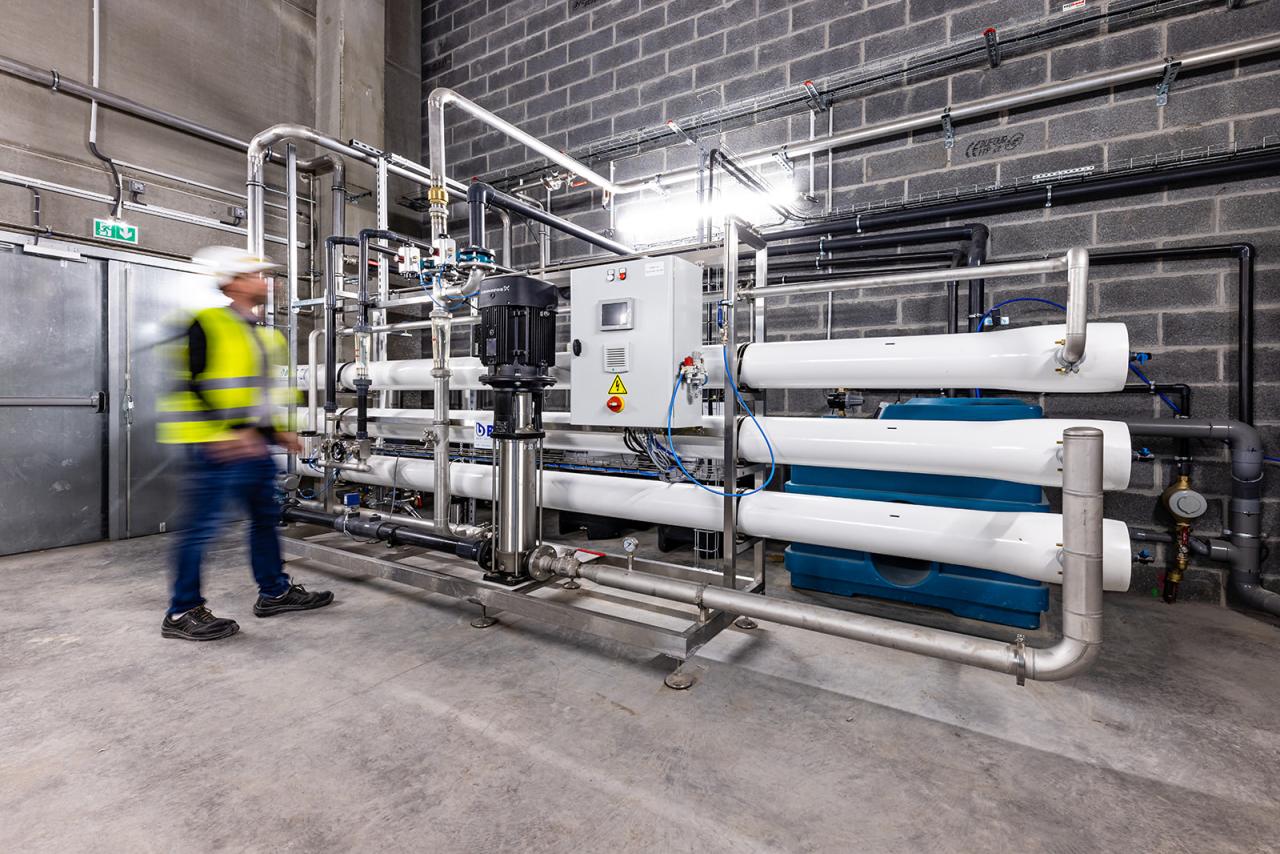
Water purified by an osmosis unit
Using an industrial osmosis unit limits the use of chemicals to purify water and eliminates the appearance of treatment by-products during operation. Reverse osmosis ensures that the water's physico-chemical properties remain unaltered, and that it achieves impeccable bacteriological quality.
As far as ingredient water is concerned, water purified by reverse osmosis achieves a level of purity that guarantees anti-bacterial safety, and complies with the latest legislation and standards on ultra-pure water. Thanks to its microbiological and physico-chemical control, an industrial osmosis unit is a key piece of equipment for ensuring the sanitary quality of water that is free from micropollutants and endocrine disruptors. Ingredient water produced by reverse osmosis helps to meet the health, safety and environmental challenges facing the sector.
Reverse osmosis, conducive to sustainability
Reverse osmosis is an effective process in terms of the sustainability of operations. For example, in utility water, reverse osmosis is used to supply a boiler with demineralised water, which increases its concentration rate and therefore its energy yield.
Downstream of production, reverse osmosis can be used to treat polluted water to restore it to acceptable levels, which can then be returned to operations. Osmosis therefore plays a direct role in saving resources and reusing them in operations, at least in part, without any additional withdrawals.
In addition, today's most efficient industrial reverse osmosis systems offer innovative functions for controlling treatment operations. In particular, technology is being used to enable uninterrupted, real-time monitoring of the equipment from a web interface, from any location. This reduces the need for staff to travel to the site.
The way the osmosis unit operates makes it a crucial piece of equipment in industrial installations. As well as ensuring the high quality of the treated water, it plays a part in a number of issues common to many industries, helping them to control their costs and environmental impact.